This note will show the following:
strict complementarity always holds for feasible linear programs (LPs).
This result is known in a very early paper by Goldman and Tucker (1956). Here we aim to give a constructive and hopefully easy to understand proof.
To explain the meaning of this statement, let us start with the the standard form of LP as the primal program

where  and
and  . The dual program is accordingly
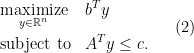
Let us now introduce the concept strict complementarity. We start with complementarity, which is a consequence of strong duality. Indeed, suppose that primal (1) and (2) are both feasible. Hence according to LP strong duality, we know there is a primal and dual pair  that are feasible for (1) and (2) respectively, and

Using the fact  is feasible, we know
  , hence the above condition is equivalent to

Letting the slack map  , and using the feasibility
  and
and  , we conclude
![\displaystyle \textbf{complementarity:} \quad x_i [z(y) ]_i= 0 \quad \text{for all}\;1\leq i\leq n. \ \ \ \ \ (5)](https://s0.wp.com/latex.php?latex=%5Cdisplaystyle++%5Ctextbf%7Bcomplementarity%3A%7D+%5Cquad+x_i+%5Bz%28y%29+%5D_i%3D+0+%5Cquad+%5Ctext%7Bfor+all%7D%5C%3B1%5Cleq+i%5Cleq+n.+%5C+%5C+%5C+%5C+%5C+%285%29&bg=ffffff&fg=000000&s=0&c=20201002)
Here  and
and ![{[z(y)]_i}](https://s0.wp.com/latex.php?latex=%7B%5Bz%28y%29%5D_i%7D&bg=ffffff&fg=000000&s=0&c=20201002) are
are  -th element of and
  respectively. The above derivation shows that strong duality (3) and complementarity (5) are equivalent for feasible and
  .
.
The equality (5) implies that at least one of and has to be  . However, it is possible that both term are zero. Strict complementarity, in this context, means that exactly one of and is zero. In another words, strict complementarity means that
![\displaystyle \textbf{strict complementarity:} \quad \text{for all}\; i \quad x_i = 0 \iff [z(y^*)]_i > 0. \ \ \ \ \ (6)](https://s0.wp.com/latex.php?latex=%5Cdisplaystyle++%09%5Ctextbf%7Bstrict+complementarity%3A%7D+%5Cquad+%5Ctext%7Bfor+all%7D%5C%3B+i+%5Cquad+x_i+%3D+0+%5Ciff+%09%5Bz%28y%5E%2A%29%5D_i+%3E+0.+%5C+%5C+%5C+%5C+%5C+%286%29&bg=ffffff&fg=000000&s=0&c=20201002)
The strict complemetarity theorem for LP states that so long as strong duality holds, then there is always a strict complementary pair, which does not hold in general for convex optimization problems. We give a formal statement below.
Theorem 1 Suppose both (1) and (2) are feasible. Then there is always a feasible pair such that (1) it is optimal for the primal and dual programs, and (2) it satisfies the strict complementarity condition (6).
We shalll utilize the following lemma to prove Theorem 1.
Lemma 2 Suppose the assumption of Theorem 1 holds. Then for any  , there either exists a primal optimal
  s.t.
s.t.  or there exists a dual optimal
  such that
 ![{[z(y)]_j >0}](https://s0.wp.com/latex.php?latex=%7B%5Bz%28y%29%5D_j+%3E0%7D&bg=ffffff&fg=444444&s=0&c=20201002) .
.
Let us prove Theorem 1
Proof of Theorem 1: From Lemma 2, we know for each  , either there is an optimal
  such that
  or there is an optimal
  such that
 ![{[z(y^j)]_j >0}](https://s0.wp.com/latex.php?latex=%7B%5Bz%28y%5Ej%29%5D_j+%3E0%7D&bg=ffffff&fg=000000&s=0&c=20201002) but not both due to (5). Hence, we can let
but not both due to (5). Hence, we can let  be the subset of
  consists of
  such that exists with
  . Consequently, using Lemma 2, we know the complement set
  consists of indices s.t. an optimal exists and
 ![{[z(y^j)]_j>0}](https://s0.wp.com/latex.php?latex=%7B%5Bz%28y%5Ej%29%5D_j%3E0%7D&bg=ffffff&fg=000000&s=0&c=20201002) . Then the desired and in (6) can be taken as
. Then the desired and in (6) can be taken as

Here  is the cardinality of . Both and are optimal due to optimality of and .
We now prove Lemma 2.
Proof of Lemma 2: Suppose the optimal value of (1) is  . Fix an index . Consider the following program

Here  is the -th standard coordidate basis in
  . Note that (8) is feasible as (1) admits optimal solutions (due to LP strong duality following from feasibility of (1) and (2)).
The dual program is

Let us now consider two situations:
- The program (8) has optimal value .
- The program (8) has optimal value less than .
Suppose that we are in the first situation. Then according to LP strong duality, the dual program (9) is feasible and has optimal value , i.e., there exist  such that

If  , then
  is optimal for (2) and we have
![\displaystyle c - A^\top\left( \frac{y}{\lambda} \right)\geq \frac{1}{\lambda }e_j \implies [z(\frac{y}{\lambda})]_j >0. \ \ \ \ \ (11)](https://s0.wp.com/latex.php?latex=%5Cdisplaystyle++%09c+-+A%5E%5Ctop%5Cleft%28+%5Cfrac%7By%7D%7B%5Clambda%7D+%5Cright%29%5Cgeq+%5Cfrac%7B1%7D%7B%5Clambda+%7De_j+%5Cimplies+%5Bz%28%5Cfrac%7By%7D%7B%5Clambda%7D%29%5D_j+%3E0.+%5C+%5C+%5C+%5C+%5C+%2811%29&bg=ffffff&fg=000000&s=0&c=20201002)
In this case, we see that satisfies the conclusion in Lemma 2.
Otherwise, we have  . Then
  and
and  . Now take any
  that is optimal for (2). Then
  satisfies the conclusion in Lemma 2.
The above shows that in the first situation, we always have a dual optimal such that ![{[z(y)]_j>0}](https://s0.wp.com/latex.php?latex=%7B%5Bz%28y%29%5D_j%3E0%7D&bg=ffffff&fg=000000&s=0&c=20201002) . Suppose we are now in the second situation. Then this directly means that there is a feasible for (8). Note such is optimal for (1) and
. Suppose we are now in the second situation. Then this directly means that there is a feasible for (8). Note such is optimal for (1) and  .
.
Our proof is complete.


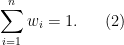







![\displaystyle \partial f(x) = - \sum_{i\in I^-_x} w_i + \sum_{i\in I^+_x} w_i + w_{I_x^=} \times [-1,1], \ \ \ \ \ (4)](https://s0.wp.com/latex.php?latex=%5Cdisplaystyle+%5Cpartial+f%28x%29+%3D+-+%5Csum_%7Bi%5Cin+I%5E-_x%7D+w_i+%2B+%5Csum_%7Bi%5Cin+I%5E%2B_x%7D+w_i+%2B+w_%7BI_x%5E%3D%7D+%5Ctimes+%5B-1%2C1%5D%2C+%5C+%5C+%5C+%5C+%5C+%284%29&bg=ffffff&fg=000000&s=0&c=20201002)
![{w_{I_x^=} \times [-1,1] = [-w_{I_x^=}, w_{I_x^=}]}](https://s0.wp.com/latex.php?latex=%7Bw_%7BI_x%5E%3D%7D+%5Ctimes+%5B-1%2C1%5D+%3D+%5B-w_%7BI_x%5E%3D%7D%2C+w_%7BI_x%5E%3D%7D%5D%7D&bg=ffffff&fg=000000&s=0&c=20201002)
![{w_{I_x^=} \times [-1,1] = 0}](https://s0.wp.com/latex.php?latex=%7Bw_%7BI_x%5E%3D%7D+%5Ctimes+%5B-1%2C1%5D+%3D+0%7D&bg=ffffff&fg=000000&s=0&c=20201002)


![\displaystyle 0 \in \partial f(x) = - \sum_{i\in I^-_x} w_i + \sum_{i\in I^+_x} w_i + w_{I_x^=} \times [-1,1]. \ \ \ \ \ (5)](https://s0.wp.com/latex.php?latex=%5Cdisplaystyle+0+%5Cin+%5Cpartial+f%28x%29+%3D+-+%5Csum_%7Bi%5Cin+I%5E-_x%7D+w_i+%2B+%5Csum_%7Bi%5Cin+I%5E%2B_x%7D+w_i+%2B+w_%7BI_x%5E%3D%7D+%5Ctimes+%5B-1%2C1%5D.+%5C+%5C+%5C+%5C+%5C+%285%29&bg=ffffff&fg=000000&s=0&c=20201002)


 Three Squirrels