We consider the following  minimization problem:

The weights  are all positive and
  . We call the optimziation problem (1) the least absolute deviation problem. Note the optimziation problem (1) has a single variable
  . If are all equal, then it is well-known that least absolute deviation has median of
  as its minimizer. In the case of unequal weights , we are going to show the median defined by the weights is again the minimizer.
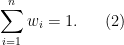
To make the presentation simpler, we assume the weights are normalized:
Without loss of generality, we assume the values  are ordered and distinct:

Next, we give the definition of median of with respect to the weights  . For each
  , we denote
  ,
,  , and
, and  be the set of indices
  such that
  ,
,  , and
, and  respectively. Note that is either a single index or an empty set.
Definition 1 We say an is a median of with respect to the weights if  and
and  , where
  if
if  is empty.
Note that under this definition, the median is acutally not always unique.
We now state the theorem that asserts the optimal solution to (1) is the weighted median.
Theorem 2 Under assumption (2) and (3), the optimal solution to (1) is any median  in the sense of Definition 1.
The key of the proof is to note that (1) is convex and a point is optimal if and only if  , where
  is the subdifferential of
  at , a generalization of derivative at .
Proof: For any , the subdifferential at is
![\displaystyle \partial f(x) = - \sum_{i\in I^-_x} w_i + \sum_{i\in I^+_x} w_i + w_{I_x^=} \times [-1,1], \ \ \ \ \ (4)](https://s0.wp.com/latex.php?latex=%5Cdisplaystyle+%5Cpartial+f%28x%29+%3D+-+%5Csum_%7Bi%5Cin+I%5E-_x%7D+w_i+%2B+%5Csum_%7Bi%5Cin+I%5E%2B_x%7D+w_i+%2B+w_%7BI_x%5E%3D%7D+%5Ctimes+%5B-1%2C1%5D%2C+%5C+%5C+%5C+%5C+%5C+%284%29&bg=ffffff&fg=000000&s=0&c=20201002)
where ![{w_{I_x^=} \times [-1,1] = [-w_{I_x^=}, w_{I_x^=}]}](https://s0.wp.com/latex.php?latex=%7Bw_%7BI_x%5E%3D%7D+%5Ctimes+%5B-1%2C1%5D+%3D+%5B-w_%7BI_x%5E%3D%7D%2C+w_%7BI_x%5E%3D%7D%5D%7D&bg=ffffff&fg=000000&s=0&c=20201002) if is nonempty and
if is nonempty and ![{w_{I_x^=} \times [-1,1] = 0}](https://s0.wp.com/latex.php?latex=%7Bw_%7BI_x%5E%3D%7D+%5Ctimes+%5B-1%2C1%5D+%3D+0%7D&bg=ffffff&fg=000000&s=0&c=20201002) if is empty. The addition in (4) should be understood as set addition:
if is empty. The addition in (4) should be understood as set addition:  .
.
Since the function is a convex function with whole domain  . Hence, an is optimal if and only if
![\displaystyle 0 \in \partial f(x) = - \sum_{i\in I^-_x} w_i + \sum_{i\in I^+_x} w_i + w_{I_x^=} \times [-1,1]. \ \ \ \ \ (5)](https://s0.wp.com/latex.php?latex=%5Cdisplaystyle+0+%5Cin+%5Cpartial+f%28x%29+%3D+-+%5Csum_%7Bi%5Cin+I%5E-_x%7D+w_i+%2B+%5Csum_%7Bi%5Cin+I%5E%2B_x%7D+w_i+%2B+w_%7BI_x%5E%3D%7D+%5Ctimes+%5B-1%2C1%5D.+%5C+%5C+%5C+%5C+%5C+%285%29&bg=ffffff&fg=000000&s=0&c=20201002)
From the the definition of median and the assumption that the weights added up to 1, it is immediate that the median satisfies the above condition and any solution satisfies the above condition is a median. 
From the Theorem 2, we know that we only need to compute the median of w.r.t. . This can be computed first by ordering the so that condition (3) is satisfied (combining same quantities). This procedure only takes  comparisons plus
  operations in creating a new set of values
  and their weights
  of combining terms and adding weights up for the same . Here
  . Then we add
  up until the
  threshold is reached to determine . This procedure again only takes additions.
 Three Squirrels